

Gold's Historic Rally: Navigating the Precious Metal's Volatility in 2025
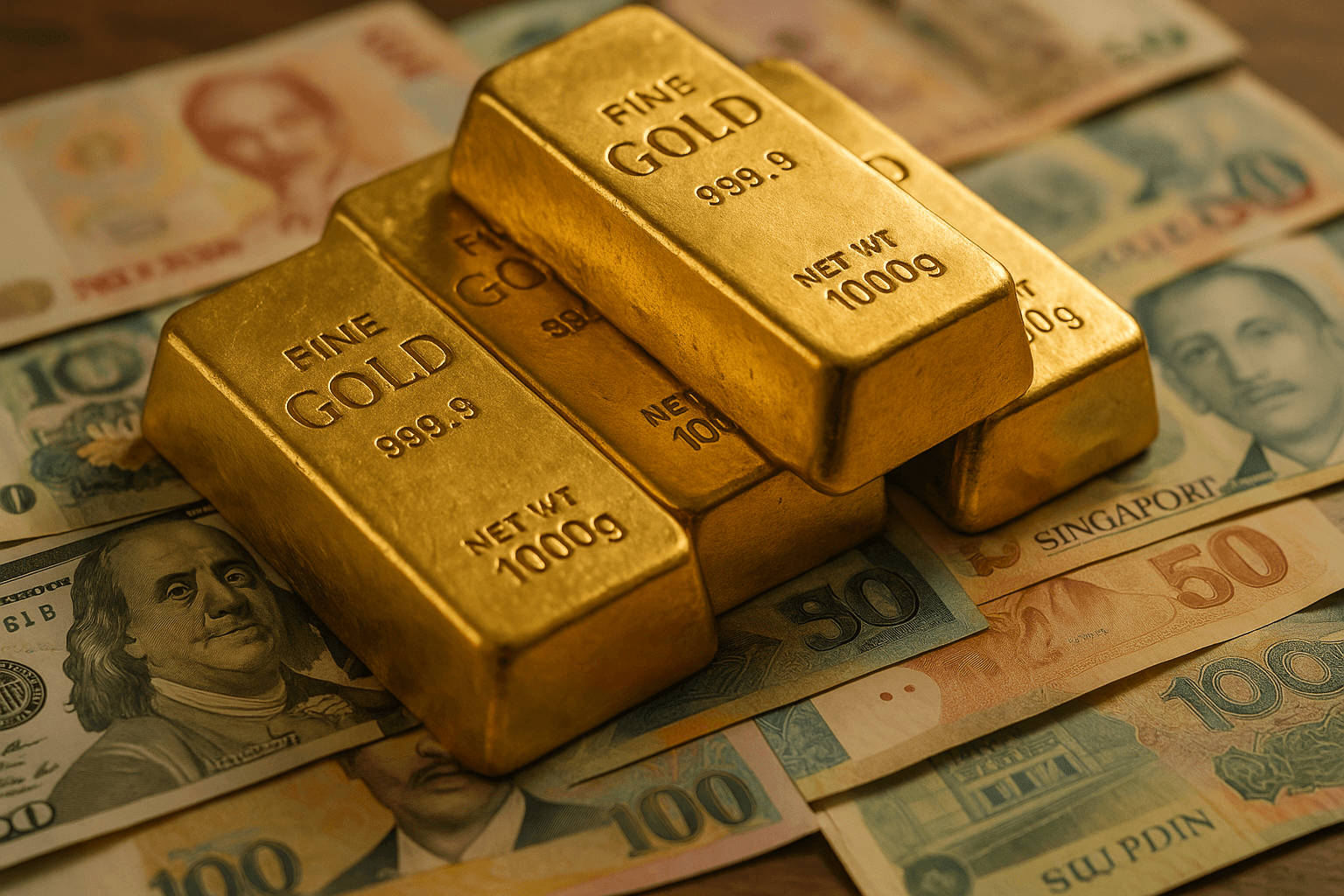
As gold prices surge past $3,500 before settling around $3,200, Southeast Asian investors face both opportunity and uncertaintyIn a financial landscape marked by geopolitical tensions and economic uncertainty, gold has reasserted its centuries-old role as a safe haven, with prices soaring to an unprecedented $3,500 per ounce in April 2025 before settling in a consolidation phase. For investors across Southeast Asia, where cultural affinity for gold meets modern portfolio strategy, this volatile yet upward trajectory presents a compelling case for reassessing gold's place in investment planning.
The Golden Ascent: Understanding Recent Price Movements
Gold's journey through early 2025 reads like a financial thriller, punctuated by dramatic price swings and historic milestones. The precious metal surged 31% in the first quarter, breaking through the $3,500 per ounce barrier in early April—a level that would have seemed improbable just months earlier.The rally's trajectory reveals a market responding to global forces:
- January-March 2025: Gold began the year at approximately $2,700 per ounce before embarking on a steady climb, driven by early signs of trade tension and central bank accumulation.
- Early April 2025: Prices exploded upward, culminating in a record high above $3,500, with futures for April delivery closing at $3,139.90 on April 2 before continuing higher.
- Mid-April Volatility: After reaching its peak, gold experienced whiplash-inducing corrections—dropping to $3,113.89 on April 4 and further to $3,012 by April 7, demonstrating the metal's characteristic volatility amid profit-taking.
- Late April Stabilization: The spot price peaked at $3,395.84 on April 21 before retreating more than 5% from its highs as trade tensions temporarily cooled.
- May Consolidation: By May 12, prices had stabilized in the $3,200-$3,250 range, finding technical support near $3,200 as markets digested both the parabolic rise and subsequent correction.
This price action illustrates gold's dual nature—capable of explosive growth in times of uncertainty while remaining susceptible to sharp corrections when market conditions shift or traders take profits.
What's Driving Gold's Remarkable Performance?
Gold's impressive ascent reflects a perfect storm of macroeconomic and geopolitical factors converging in 2025:
Geopolitical and Trade Tensions
The announcement of sweeping U.S. tariffs—including a 10% blanket tariff and a 25% levy on imported vehicles—sparked fears of a global trade war. President Trump's "Liberation Day" tariffs and China's retaliatory measures heightened recession concerns, sending investors flocking to gold's perceived safety.More recently, U.S.-China trade negotiations have offered glimmers of hope, temporarily reducing safe-haven demand, while continuing tensions in the Middle East have provided counterbalancing support for prices.
Currency Dynamics and Monetary Policy
The U.S. dollar's 9% year-to-date decline has significantly enhanced gold's appeal. "Gold's inverse relationship with the dollar remains one of its most reliable price drivers," notes Sarah Chen, commodities strategist at HSBC. "For Southeast Asian investors, this currency effect essentially provides a double tailwind when the dollar weakens."Meanwhile, the Federal Reserve's pause on rate hikes keeps real yields low, increasing gold's attractiveness as a non-yielding asset. Markets now indicate a 72% probability of easing by September 2025, a scenario historically favorable for gold prices.
Institutional and Central Bank Demand
Perhaps most significantly, central banks globally have maintained an aggressive buying stance, with net purchases averaging 710 tonnes per quarter in 2025. China's central bank has been particularly active, continuing a multi-year strategy of reducing dollar exposure while increasing gold reserves."Central bank buying provides a fundamental floor under the gold market," explains Dr. Nguyen Minh, economics professor at Vietnam National University. "This institutional demand represents a structural shift rather than cyclical behavior, suggesting long-term support for gold prices."This institutional activity has coincided with record options trading in gold ETFs, with over 1.3 million contracts traded in mid-April, reflecting both speculative interest and strategic hedging by large investors.
Strategic Considerations for Southeast Asian Investors
For investors across Southeast Asia, gold's recent volatility presents both challenges and opportunities. Here are key considerations for navigating this dynamic environment:
Understand Regional Price FactorsWhile global forces drive underlying gold prices, regional factors can significantly impact local valuations and investment outcomes:
- Currency Effects: Local currency movements against the U.S. dollar can amplify or diminish gold returns for Southeast Asian investors. For instance, Vietnamese investors benefited when the dollar weakened in early 2025, effectively enhancing their gold returns in VND terms.
- Premium Differentials: Physical gold typically trades at varying premiums across different Southeast Asian markets, with factors like import restrictions and local supply-demand dynamics creating price disparities worth monitoring.
Just one step to unlock the rest of this article
Sign in to read the full article and access exclusive content
✨ Completely free • No credit card required